How to Choose Robotic Welding Consumables
What you should know to improve performance and reduce costs
When you invest in automation, the goal is to gain productivity and quality improvements that set your welding operation apart from the competition and help increase your bottom line. To achieve success with an automated welding system, however, you need to ensure that the parts you are welding are consistent and repeatable, confirm that your welding operation has good workflow and have properly trained welding operators to oversee the system. You also need the right equipment for the job.
In addition to working with a reliable robotic integrator to select and implement the robot, you should also take care to select the right robotic MIG gun and consumables — contact tips, nozzles, liners and retaining heads — for the application. The consumables, in particular, are an easily overlooked part of an automated welding system, but they can have a measurable impact on downtime and day-to-day costs. Consider these suggestions for getting the best performance from these components.
Mind Your Extensions and Connections

of an automated welding system, but they
can have a measurable impact on
downtime and day-to-day costs. Be
certain to carefully select and maintain
them to get the best performance
and minimize downtime.
The contact-tip-to-nozzle relationship for an automated welding system varies according to the application, but it still has an impact on the welding performance and quality you achieve. Applications that have complex joints or tooling often require an extended contact-tip-to-nozzle relationship. This relationship provides greater access into more complex joints and can help you better accommodate for complex tooling. You should be mindful that this relationship also makes your contact tip more prone to spatter accumulation and may reduce the tip life due to it being more exposed to the heat of the arc. The application of an anti-spatter compound can offer some protection against such situations, but you will also need to monitor your contact tips regularly for signs of wear. Remember, preventive maintenance is better than downtime for resolving problems. Change over your contact tips before issues occur.
Using heavy duty copper contact tips is a good option for reliable performance in many welding applications. Contact tips with a hardened insert are ideal for operations employing pulsed welding, as they resist wear from the harsh waveforms, and last 10 times longer than copper or chrome zirconium tips.
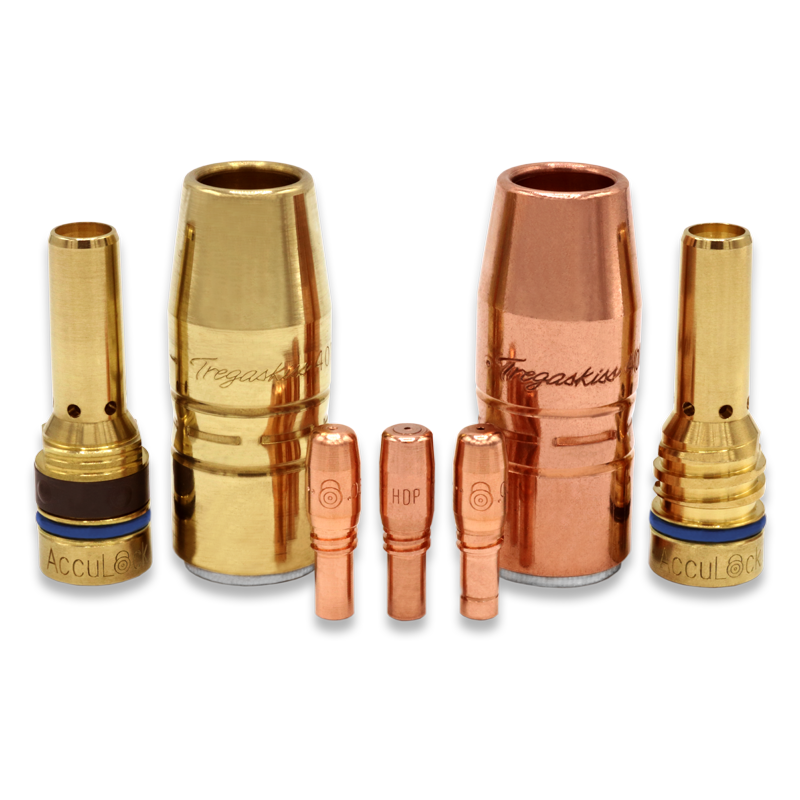
Checking your contact tips, retaining heads (or diffusers) and nozzles for good connections can also have a measurable impact on your welding performance. Solid connections help ensure reliable electrical conductivity and minimize heat, which in turn provides more consistent weld quality and helps your consumables last longer.
Look for contact tips with a long tail and coarse threads, as these help prevent cross-threading and downtime for troubleshooting associated issues like poor penetration. This design aligns the contact tip tail concentrically within the diffuser before the threads engage, making the contact tips easier for less experienced welders to install correctly. These same style contact tips also include greater mass at the front of the tip and bury the tip further in the diffuser than other styles. Such features help the contact tip last longer by resisting wear from the heat of the arc. Longer lasting contact tips mean less downtime for changeover and less risk of installation errors. Also, consumables with tapered mating surfaces provide good electrical conductivity to extend the life of the products.
The Impact of Welding Wires on Contact Tip Selection
The welding wires you use can impact the performance of your contact tips and it can also affect what size you should use. Larger drums of wires — 500 to 1,000 pounds — are commonly used for automated welding systems to minimize changeover; however, the wire in these drums tends to have less of a cast and/or helix than wire that feeds off of a smaller spool. As a result, the wire often feeds through the contact tip relatively straight, making little or no contact with it.
The effect is twofold: one, it minimizes the electrical conductivity necessary to create a good arc and a sound weld; and two, it can cause the welding wire to contact the part being welded and arc back into the contact tip, thereby creating a burnback. This condition automatically creates downtime to change over the contact tip. As a solution, consider undersizing your contact tips particularly if you are using a solid wire. For example, a .040-inch (1 mm) diameter contact tip could work for a .045-inch wire. Check with a trusted robotic integrator or welding distributor if you are using metal-cored wires, as undersizing them is not always feasible due to their tubular construction.

You should also consider the impact that the wire you are using has on the longevity of your contact tip. For example, non-copper-coated solid wires tend to wear contact tips (and liners) more quickly than copper-coated ones. The copper on a copper-coated wire acts like a lubricant to improve feedability and can often extend consumable life. It may be worthwhile to factor in the higher up-front cost of these wires compared to the increased cost of purchasing more contact tips for use with a non-copper-coated wire, as well as the downtime for changeover.
What is Your Mode of Welding?
Automated welding systems require consumables that are capable of withstanding longer periods of welding — and most often higher amperages — than a semi-automatic application. The specific mode of transfer for (GMAW) or (MIG) welding you use can also impact the type of consumables you require. For example, pulsed welding programs in which the power source “pulses” between low background currents and high peaks, are especially harsh on consumables due to the higher levels of heat that the process generates. They tend to cause the contact tip to erode more quickly and therefore require more frequent changeover.
You should carefully monitor your contact tip usage if using such a welding program so that you can determine how often the contact tips need to be replaced. Changing over these consumables before they experience problems can help prevent issues like loss of electrical conductivity, burnbacks or excessive spatter accumulation, the latter of which tends to occur when the contact tip becomes too hot and the consumable material softens. Use the time during routine pauses in production for contact tip changeover to avoid interrupting arc-on time.
Selecting the Right Nozzle … and Maintaining It
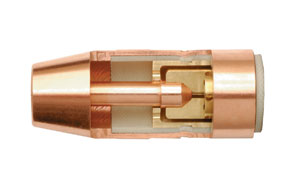
Typically, the tooling on your automated welding system dictates the type of nozzle that you will need to use. Bottleneck, straight or tapered nozzles are common choices since they are narrower than standard nozzles and can provide better access around tooling or into complex joints. Still, always consider the duty cycle and amperage of your application when deciding which nozzle to use. The more tapered a nozzle, typically the thinner it is and the less able it is to withstand higher amperage or higher-duty-cycle applications. If your automated welding system welds at higher amperages (300 amps or greater) and has high levels of arc-on time, it may be a good idea to select a heavy-duty style since these have thicker walls and insulators and are more able to resist heat. Nozzles composed of copper are also a good option, as are those featuring high-temperature fiberglass insulators. Work with your robotic integrator or welding distributor to make the right nozzle selection. Remember that you need to be sure to select one that provides access to the joint, but that is not so narrow (especially in relation to the contact tip) that you compromise shielding gas coverage or unnecessarily shorten the consumables’ life.

and contact tips.
For all styles and types of nozzles, it is always recommended that you employ a nozzle cleaning station or reamer to help maintain them. A nozzle cleaning station cleans the robotic gun and nozzle of spatter and clears away debris in the retaining head that accumulates during the welding process. These stations can also be outfitted with a sprayer that applies a water- or oil-based anti-spatter compound to protect the nozzle, retaining head, and workpiece from spatter after it has been cleaned. The nozzle cleaning station should be placed close to your robot so it is easily accessible. Also, you should program your robot to use it in between cycles — during part loading or tool transfer — so as not to interrupt your welding operation. It should only take a few seconds for the nozzle cleaning station to complete its job.
Other Considerations
As a general rule, it is best to select consumables that are well-machined and have smooth, round surfaces, as these are less prone to collecting spatter and tend to last longer. It is also important that you use the heaviest-duty consumables for your application that will still allow you access to tooling. Doing so can help extend their life.
Keep in mind that you also need to pay attention to your retaining head selection and the liners that you use in your robotic MIG gun. The retaining head should match your nozzle and contact tip appropriately and offer a secure connection so that you obtain the best conductivity. Also, always trim and install liners according to the manufacturer’s recommendation, using a liner gauge to determine the appropriate length. A liner that is too short or too long can cause wire-feeding problems that require downtime to rectify.
As with any part of an automated welding system, the goal is to keep your consumables in working order so that you spend more time reaping the benefits of the process and less time troubleshooting problems.
There are regular job shops. Then there are job shops that go far beyond basic fabrication — ones that design, machine, laser cut, manufacturer and inspect specialty components from start to finish. Watson Engineering, Inc. of Taylor, Mich. is just such a one. What began as a one-person fabrication shop nearly thirty years ago is now a full-service manufacturer of prototype tubular and sheet metal components, along with products for the automotive and commercial industries. And whether its welding operators are retrofitting race cars with roll cages or manufacturing high-volume runs of heavy equipment components, Watson prides itself on one simple philosophy set forth by founder, Chuck Watson: “Customers come to Watson Engineering with problems they need help with – and we make the problems go away.” The company has been able to achieve this goal through a lot of hard work and even greater innovation. Not to mention, this job shop is lean. Every tool, every bin and every piece of welding equipment has its place — and that place has been chosen for maximum efficiency. In fact, the entire organization of Watson’s facility has been the result of all of its employees’ commitment to the company’s lean initiatives, from concept to painting and shipping. Not surprisingly, as part of its ongoing innovation and its lean initiatives, Watson decided to look as closely at its robotic welding cells, too. In doing so, they decided to convert to Tregaskiss’ TOUGH GUN I.C.E.® robotic MIG gun in order to solve a long-standing problem: finding a durable gun that could maintain its accuracy after a collision. They also added several of Tregaskiss’ air-cooled TOUGH GUN robotic MIG guns to other welding cells. After adding the products, they were surprised to find a few extra benefits that directly support their lean initiatives and have also contributed to a 25 percent increase in Watson’s overall productivity. Watson prides itself on the ability to produce components that have exceptionally intricate or complex designs. Not surprisingly, such designs can pose some particular challenges to the welding process, especially when the components are comprised of a wide range of materials and material thicknesses. According to Rafael Velasquez, robotic supervisor at Watson, in any given day the company may weld exhaust manifolds for an automotive customer, hood hinges for a commercial customer and thousand pound internal components for a heavy equipment manufacturer — sometimes in the same work shift and the same robotic welding cell. Not to mention, all the products undergo rigorous quality control testing (Watson even performs 100 percent lot tests on some parts), so quality is key and downtime is simply not an option if they are to create top notch products on a tight schedule. One of the biggest obstacles that Velasquez and his fellow Watson welding operators have faced over the years is finding a robotic MIG gun that could “take a hit without bending the neck” after a collision. Despite the best precautions, robotic welding collisions are a very real problem, resulting most often from tooling clamps not being secured. If the robotic MIG gun neck bends, it must be adjusted or replaced since the robot’s tool center point (TCP) will change and have a negative impact on the quality of subsequent welds. “We’re always changing parts and tooling,” explains Velasquez. “Unfortunately, you can bend two or three necks in a week because of it. Somebody would miss a clamp and leave it up. It happens.” After enough bent necks, downtime and just plain frustration, Velasquez opted to contact Watson’s long-time distributor, Dan Gnesda of Roy Smith Company in Detroit for help. Gnesda recommended the TOUGH GUN I.C.E. Robotic MIG Gun and the results, per Velasquez, have been worthwhile. Prior to converting to the TOUGH GUN I.C.E. robotic MIG gun, Watson used a competitive brand water-cooled gun, which Velasquez explains was quite costly and time-consuming to fix after a collision. Fundamentally, necks for water-cooled robotic MIG guns tend to be weaker than air-cooled designs and involve more work to replace, in major part because the water lines run internally through the power cable, gun and neck. To replace the water-cooled neck after a collision, Velasquez and his team needed to disconnect the neck from the gun and unhook the water lines by removing clamps that were crimped around them — a process that took about 30 minutes. Converting to the TOUGH GUN I.C.E. robotic MIG gun, however, seems to have offered Watson the best of both worlds: the durability of an air-cooled MIG gun and the cooling capacity of a water-cooled gun. I.C.E stands for ‘Integrated Cooling Enhancer’ and aptly describes the design of the gun, as it is a ‘hybrid’ between conventional air- and water-cooled designs. The TOUGH GUN I.C.E. robotic MIG gun features stainless steel water lines that run along the outside of the gun’s neck down to the nozzle, rather than through the neck like true water-cooled products. This design provides water circulation that keeps the consumables of the gun running cool, but because the lines are external (instead of running through the neck), the gun’s neck has more mass and is stronger, much like that on an air-cooled gun. According to Velasquez, the necks on the TOUGH GUN I.C.E. robotic MIG guns “can take the hit” most times after a collision, and in the event that the neck does bend, it can be replaced in about five minutes — a timeframe that fits nicely into Watson’s overall lean initiatives. The TOUGH GUN I.C.E. robotic MIG gun also features water shut-off valves at the I.C.E. connections and a quick-change neck feature. To disconnect the neck, Velasquez simply loosens a setscrew on the gun housing, disconnects the quick-change fittings for the water lines and slides on a new neck. After reconnecting the water lines and verifying his TCP, he can get the welding operation up and running again. “My emergency calls from Watson used to come through every other week with the previous gun, because of the crashes,” explains Gnesda. “After replacing the necks, there could be leaking or something else that was off. Now with the TOUGH I.C.E. gun, well, I hear from them every couple of months.” And because, the TOUGH GUN I.C.E. robotic MIG gun provides up to 550-amp capacity (at 60 percent duty cycle with mixed gases), it provides Watson with another solution that fits their goals for creating a lean facility: it can weld on a variety of material thicknesses. There is no need to change out robotic MIG guns to accommodate for the ever-changing flow of components that make their way through the weld cell each day — a factor that saves Watson money and time. “We have a lot of high amperage, high voltage welds. And we weld on thinner metals, too,” explains Velasquez. “Some of our components are thirty-millimeters thick and others are as thin as three mils. I can weld both. I just have to change out the wire.” As with the durability of the gun’s neck and the occasional changeover, being able to use the same gun for all its parts has contributed significantly to Watson’s lean initiatives. “There’s so much going on here with all the parts they weld, it’d be very easy for things to get out of control.” says Gnesda, “But these guys have a handle on everything. I think the I.C.E. is helping with that.” The goal of Watson’s lean initiatives has been to improve workflow, minimize downtime and, of course, improve productivity and profitability. After converting to the TOUGH GUN I.C.E. Robotic MIG Gun, and also adding several Tregaskiss® TOUGH GUN® robotic MIG guns to their other welding cells, Watson found that their equipment maintenance also became easier and they reduce their inventory, too — both benefits they had not anticipated. Velasquez first noticed that the total cost of maintaining the TOUGH GUN I.C.E. robotic MIG gun was substantially lower compared to the conventional water-cooled MIG gun Watson used previously. In addition to the fact that the necks have been more durable and easier to replace when needed, he found that the gun’s unicable has been equally robust. In fact, according to Velasquez, he only just recently changed out the original unicable that came with the TOUGH GUN I.C.E. robotic MIG gun two and a half years ago. “We’ve been running around the clock, six days a week each year with the same one,” he explains. “To change it, I just loosened a couple of screws, popped it out and put on the new one. With the addition of a new liner, I just connected the unicable back at the feeder. It took me fifteen minutes and we’re done.” Saving the cost of purchasing unicables on a regular basis has been a welcome benefit for Watson, as has its reduction in inventory for this and other MIG gun parts. Since Velasquez began using the TOUGH GUN I.C.E. robotic MIG gun and the air-cooled TOUGH GUN MIG guns for his other welding cells, he has also been able to reduce his inventory for necks significantly, too, as many are interchangeable. “I used to have so many necks in stock, sometimes about fifteen different ones. Now I’ve got three necks I can use on all the robots. I don’t have to have so much inventory to keep this place running,” says Velasquez. He’s also been able to reduce his consumables inventory. Both the TOUGH GUN I.C.E. Robotic MIG Guns and the standard TOUGH GUN MIG Guns operate on Tregaskiss’ Common Consumable Platform, meaning that the front-end consumables — nozzles, contact tips, retaining heads and liners — are the same for both guns. Velasquez explains that he uses standard and heavy-duty TOUGH LOCK® consumables for all the guns, depending on the thickness of the parts his robots are welding and at what amperage. He simply orders the parts that correspond to the different wires he uses between part runs. Velasquez also explained that when he changes over the contact tips on his robotic MIG guns, he then uses them for the semi-automatic MIG guns Watson uses in other portions of the facility. So what’s the bottom line of these and all the other benefits Watson has found with its lean initiatives? According to Velasquez, Watson’s lean initiatives — including the benefits brought forth from the TOUGH GUN I.C.E. robotic MIG guns and other Tregaskiss products — have combined to provide a 25 percent increase in the company’s productivity. The process is ongoing, of course, but it’s been made easier by the commitment of Watson’s employees who have all played a significant role in organizing the facility, from the concept phase of the many components it manufactures to the machining, storing and assembly of the parts. Having a durable, easy-to-maintain robotic MIG gun and minimizing Watson’s inventory has definitely helped improve workflow and reduce downtime, too. “We’re serious about lean,” says Velasquez. “We try to complete jobs from concept to finish within days. The I.C.E. and other Tregaskiss products have definitely helped us.”
It doesn’t take much to create a MIG weld. All you really need is a power source, some CO2, a MIG gun, ground cable and a wire electrode. Of course, that doesn’t mean you’ll end up with a mechanically sound or decent looking weld. Achieving those results requires a strong skill set, close attention to detail and the right MIG welding consumables (among other things, of course). Often overlooked during the purchasing process MIG gun consumables — the contact tip, nozzle and diffuser — are the decisive variables in electrical transfer to the wire and shielding gas to the weld pool. No matter how well tuned the rest of your welding equipment is to your application, without the right consumables in properly functioning order, your weld quality will suffer. Obtaining high quality welds and high productivity rates requires attention to the type of consumables you purchase, how they are installed and used by your welding operators and accurately troubleshooting consumables problems when they arise. Selecting high quality consumables is paramount to obtaining high quality welds and avoiding unnecessary downtime. High quality consumables provide better shielding gas coverage of the weld, resulting in less porosity and a more stable arc, as well as longer contact tip and nozzle life, reduced burnbacks and fewer weld defects caused by loose consumables fittings. With labor accounting for roughly 85 percent of a welding operation’s expenses, the slightly higher cost of high quality consumables can quickly be offset by these advantages. Another labor-related factor to consider when selecting consumables is the time it takes to change contact tips. A non-threaded contact tip that can be changed by dropping it into the diffuser, without tools, and locking it in place via the nozzle can often cut changeover time in half. Further, consumables systems that can be mounted to a wide variety of gun brands reduce the time it takes to locate a replacement tip and reduces the inventory footprint and time spent monitoring and ordering new product. Equally important is choosing the right consumables for the application. For example, using heavy-duty nozzles, with thick-walls as well as wide nozzle bores, will only add weight and reduce weld pool visibility in low-amperage, thin-gauge applications. Likewise, using thin-walled brass nozzles with narrow nozzle openings in heavy-duty applications could result in inadequate shielding gas coverage, frequent burnbacks and MIG gun consumables are exposed to more heat and mechanical stress than any other component in your MIG welding system, so even the best consumables you can buy will wear out and need to be replaced on a regular basis. While this can’t be avoided, correctly using the consumables can lengthen their service life and improve weld quality. Maintaining the correct contact tip stick out or recess, as it relates to the end of the nozzle, is crucial to ensuring good weld results. The amount that a contact tip is recessed or extended past the nozzle determines the wire stick-out and how much heat from the arc the contact tip absorbs. High current, high heat applications generally require a contact tip recessed up to 1/4” from the end of the nozzle. Lower amperage applications, or those with narrow joint configuration, might require a flush or extended contact tip. Contact tips are available either as adjustable or with a fixed recess. Adjustable recess contact tips allow you to simply raise or lower the contact tip to your liking, but they also increase the potential for human error, particularly in welding operations where multiple operators use the same gun. Fixed recess contact tips need to be changed when changing to a different application, but they standardize the weld process and eliminate a variable that can affect welding performance. Below is a chart showing the recommended tip recesses for a variety of applications and processes. Regularly inspecting, cleaning and adjusting the consumables is also critical to ensuring weld quality. A nozzle that becomes clogged by spatter can restrict shielding gas flow and lead to porosity. You can use a welder’s pliers or a nozzle reamer to clear out any spatter that builds up. Likewise, the contact tip can develop an oval shaped bore, called keyholing, from the welding wire passing through it, which can cause interruptions in electrical current to the wire, resulting in an unstable arc, porosity and other problems. Some brands of contact tips can be rotated to provide additional contact surface when the wire wears out a portion of the bore. Unfortunately, no amount of deliberation and careful use can completely eliminate problems from occurring. Being able to quickly and accurately troubleshoot problems when they do occur, however, can reduce the impact of the problem and the downtime that you incur. Generally speaking, the best way to troubleshoot a problem is to use the process of elimination to move from the least to the most time consuming equipment to check. Contact tip burnback, where the welding wire fuses to the contact tip, occurs occasionally if the tip gets too close to the weld pool, but it could also indicate an equipment problem if it occurs frequently or happens when the contact tip is not too close to the weld pool. Some common sources of contact tip burnback are: incorrect contact tip recess, a faulty work lead or ground, and erratic wire feeding (discussed below). Erratic wire feeding is usually caused by an obstruction or kink in your liner, incorrect or improperly tensioned drive rolls or a worn out or wrong sized contact tip. If this problem is encountered, inspect the contact tip, then check the drive rolls and finally remove and inspect the liner if the first two items are functioning properly. Replace any of these items that appear worn or damaged. An erratic arc can be caused by erratic wire feed, but is most commonly a result of inconsistent electric current being delivered to the wire. A gun neck that is too straight or a worn out contact tip are common sources of an erratic arc. If the contact tip appears in good working order and the neck is at least a 30 degree bend, check the electrical connections between the components to ensure they are tight and free of debris. Spatter is a common occurrence in MIG welding, but excessive spatter could signal an equipment malfunction. Either too much or too little shielding gas flow as well as an improperly installed contact tip are common causes of excessive spatter. Try adjusting these components first, before moving on to other possible causes. Porosity — small holes in the weld bead — is another common outcome of too much or too little shielding gas. Begin troubleshooting porosity by checking that the nozzle is not clogged by spatter. If the nozzle is clear, move on to check that the gas ports are not blocked by an obstruction, that the solenoid is working properly and that the o-rings at the back end of the MIG gun are not damaged. Also check the electrical connections at the MIG gun, ground clamp and consumables to make sure they are providing good electrical transfer. Although some troubleshooting can’t be avoided, you can greatly reduce your downtime spent changing contact tips and troubleshooting weld defects by carefully choosing your MIG gun consumables and carrying out a regular inspection and maintenance schedule. Laying down a strong, great looking MIG weld is no easy task, but doing so with poor quality or improperly configured equipment is virtually impossible. The little time you spend researching, choosing and maintaining your equipment will save you a considerable amount of time, and headaches, down the road.
Everyone is trying to save money these days. From implementing lean practices to repairing equipment instead of purchasing new, companies are seeking ways to reduce costs without sacrificing quality. Selecting the right MIG gun consumables for your welding application can also help. Not only can the right consumables minimize unscheduled downtime for changeover, but they can also reduce the need to rework weld defects caused by a poorly performing contact tip, nozzle or liner. The bottom line? You can spend more time welding, gain greater productivity and lower your costs. Following are some suggestions for selecting the most appropriate MIG gun consumables for your application and ways you can best care for them. Liners are responsible for guiding the welding wire from the wire feeder, through the gun cable and up to the contact tip. They are typically composed of steel coils, but can also be made of nylon or Teflon®, the latter of which is used for welding with aluminum wire. Selecting a liner is a relatively straightforward process: you need to match the liner’s inside diameter (within a specific range) to the diameter of wire you are using. For example, if you are welding with a .035-inch wire, you can use a liner that measures .035 to .045 inches in diameter. Making this match helps prevent wire-feeding problems that can lead to poor arc stability, bird-nesting (a tangle of wire that prevents the wire from feeding) and/or weld defects. Also, using premium quality liners is best, as these maintain a more consistent inside diameter than less expensive ones and provide better feeding performance. To prevent shielding gas leaks that can increase costs and jeopardize gas coverage of your welding puddle, make certain that your liner has a good O-ring connection at the back of the liner and that you select liners with a durable coating. Replace your liner at a regularly scheduled time and always follow the manufacturer’s recommendation for trimming and installation. Poorly trimmed liners, liners that are worn excessively or ones that are kinked from use can easily cause wire feeding problems or an erratic arc that leads to poor weld quality. They can also cause excessive spatter that will require post-weld grinding, minimizing throughput and adding to your overall costs. Some manufacturers offer partial liners that replace only the most commonly worn part of liner (along the length of the MIG gun) instead of the entire liner. These partial liners help reduce downtime for changeover as they usually take about half the amount of time to install compared to a full-length liner. While they may look like a small, and perhaps insignificant, part of the overall welding system, contact tips play a critical role in helping achieve good weld quality, reducing costs for downtime and minimizing rework. In addition to helping direct the welding wire to the weld puddle, contact tips are responsible for transmitting the current to that wire in order to initiate the arc. The contact tip you select should correspond with the diameter of welding wire you are using. Typically, contact tips are available to accommodate wire diameters ranging from .023 to 1/8 inches. Depending on the type of joint your application requires, you may need to select a tapered style contact tip. These contact tips are good for applications that have restricted joint access, but they tend to be a bit more delicate than non-tapered contact tips. They should be coupled with a tapered nozzle. If joint access is not a factor in your application, however, choosing a non-tapered contact tip is the best option as it has more mass and will last longer. Different manufacturers offer either threaded or non-threaded styles of contact tips. Threaded contact tips are the most common and, as their name implies, they are held in place in the gas diffuser by threading or twisting them. Non-threaded contact tips, conversely, drop into the gas diffuser. This latter style of tips can be rotated when the contact tip starts to wear on one side (called keyholing) in order to create a new wear surface, extend the life of the contact tip and prevent arc instability that can in turn lead to spatter and rework. Non-threaded contact tips also tend to be easier to change out after a burnback, which is the formation of a weld in the contact tip. It most often occurs because of placing the contact tip too close to the workpiece or using too slow of a wire feed speed. Regardless of whether you choose a threaded or non-threaded style of contact tip, it is important that you install these according to the manufacturer’s recommendations. Doing so will help ensure a good electrical connection and, with it, reliable welding performance and quality. Contact tips are generally available in sizes small or large and also in standard or heavy-duty varieties. If you are welding on higher temperature applications (generally, 300 amps and above) you should select a large contact tip, as these have greater mass and provide better cooling capacity than smaller contact tips. For higher amperage applications that also require prolonged welding, heavy-duty contact tips can provide greater conductivity, improve arc starts and they tend to provide longer lasting performance. Lighter amperage applications (generally, below 300 amps) are well-suited to using small, standard style contact tips. To ensure the best welding performance, inspect the contact tip for spatter build-up on a regular basis and replace as needed. Waiting too long to replace a damaged contact tip can lead to arc irregularities and poor weld quality, not to mention unscheduled downtime for replacements, which can cut into your productivity and cost you money. Depending on your application there are a variety of styles of nozzles from which to choose. Like contact tips, nozzles are an important part of gaining good weld quality and reducing costs. The main function of these components is to direct shielding gas to the weld. For that reason, you want to select a high-quality nozzle that is capable of providing smooth gas coverage and resisting damage (e.g., dents, scratches, etc.). Usually, manufacturers offer either brass or copper nozzles. Brass nozzles provide good protection against spatter, while copper nozzles withstand heat better, particularly on heavy-duty applications. There are two main styles of nozzles — threaded and non-threaded — as well as a variety of different shapes and sizes. Threaded nozzles tend to maintain a more secure connection than non-threaded styles, which protects against shielding gas leaks that can lead to weld defects like porosity. These nozzles also help keep the contact tip centered for greater accuracy. Non-threaded nozzles, however, are easier to change over. Nozzles are available with small and large varieties and a range of inside diameter measurements, often from 3/8 to 5/8 inches. Ultimately, the best option for any application is to use the largest nozzle possible that still provides you access to the joint. Doing so provides greater gas coverage to protect against contaminants. For restricted joints, however, you will need to use a small, tapered nozzle that allows you to place the contact tip close to the weld puddle. Or if you have a high-amperage application that requires high gas flow rates, select a large diameter nozzle, as it provides the best shielding gas coverage. Some MIG consumable manufacturers provide nozzles that keep the contact tip at a fixed position: flush, recessed or extended. Each provides distinct attributes. For example, if you are welding in a short-circuit transfer mode, a nozzle that keeps the contact tip flush to the end of the nozzle or slightly extended helps minimize the spatter that tends to be generated in this welding process. Similarly for spray arc transfer or pulsed spray mode when welding with solid wire, having a nozzle that keeps the contact tip slightly recessed can help the contact tip operate at cooler temperatures and provide greater shielding gas coverage. For all styles and sizes of nozzles, regular inspection for spatter is crucial to achieving good gas coverage. Also, careful handling and storage of these consumables is important. Always wear gloves when changing out nozzles to prevent debris or oils from adhering to them and entering the weld puddle. To prevent damage, keep them in the original packaging until you are ready to use them. Remember, whether you are selecting a nozzle, contact tip or liner, having the right MIG gun consumable for your application can go a long way in reducing unnecessary downtime and lowering your overall costs.
When you have a company that fabricates its projects by the tons and measures its man-hours by the thousands, downtime simply isn’t an option. The welding operators and supervisors at Brooklyn Iron Works know that fact better than most. The Spokane, Wash.-based company, whose steel fabrication spans from bridges in Alaska to projects in Antarctica, tackles some of the highest-profile, high-inspection jobs around. And they rely on some good old-fashioned teamwork, among other attributes, to meet their deadlines. “Everything we do is a team effort,” QA Manager Phil Zammit explains. “We’re a good company with skilled employees and good management. It makes us a premium company here in the Northwest.” It also makes them a reputable one. Brooklyn Iron Works doesn’t maintain a sales force, but instead relies — and successfully so — on its reputation and word of mouth to generate business. Scott Allen, the company’s general manager, explains that they are invited to bids based simply on the quality work they do and the timeliness in which they do it. Last year, Norco Gas & Supplies representative Tim McGrath approached Zammit and Allen with a proposition to make their welding operations even better: a two-week trial of Bernard Centerfire™ consumables on their existing MIG guns. According to Zammit, they had tried Bernard products years before and didn’t think they were the right fit for their application. Still, he decided to keep an open mind and agreed to the trial. Two weeks later, he invited McGrath to convert the front-end of all 25 of the company’s MIG guns to Centerfire consumables and shortly thereafter, converted to Bernard’s Q-Gun™ MIG guns too. The reason? Less downtime. Brooklyn Iron Works, according to Allen, fabricates projects ranging from 650 to 2,000 tons or more, including fracture critical structural components for bridges, demand-critical welding on columns, beams and moment connections bound for seismic locations, like California. Not surprisingly, the company maintains a workforce of highly skilled certified welders certified to the AWS D1.1 (Structural Welding Code – Steel), D1.8 (Structural Welding Code – Seismic) and D1.5 (Bridge Welding Code). Many projects take between nine months and a year from start to finish. Depending on contract and/or code specifications, every weld at Brooklyn Iron Works is visually inspected and oftentimes includes 100 percent NDE (nondestructive examination) including MT, UT or RT. Others undergo random NDE testing for quality monitoring purposes. The company maintains a staff of certified welding inspectors (CWIs), as well as hosting contracted NDE inspectors, to manage these tasks. They also have a cleaning and painting facility to finish products after welding and prior to shipment to customers. Gaining access to the weld joints is one of the biggest challenges welding operators at Brooklyn Iron Works encounter while creating these welds. They weld mostly structural steel grades, with the majority being A36, A572 Grade 50, A500 and A709 steel including weathering types. Thicknesses range from 1/4 to 2-1/2 inches. On deep and tight joints, reaching the root of the joint for the initial root pass requires not only the right type of MIG gun and nozzle, but also welder dexterity. With the company’s previous consumables, welding operators often had to extend their electrode stickout as far as 2 inches to access the joints, a practice that risked generating porosity since it could compromise the necessary shielding gas coverage. Another challenge the company faced was the occurrence of burnbacks, the formation of a weld inside the contact tip, when using their old brand of contact tips. Brooklyn Iron Works welding personnel run their weld beads at high amperages (300 to 400 amps) using typically .052- or 1/16-inch FCAW wire diameters, which often proved too harsh on their previous contact tips. They would loosen after routine welding, causing the wires to arc back and create the burnback. The trial of Centerfire consumables gave Zammit and his team of welding operators a solution to these two problems—and it led to a MIG gun conversion that provided some additional benefits, too. When McGrath initiated the trial of Centerfire consumables at Brooklyn Iron Works, he started by installing them on just two MIG guns, using a conversion adapter offered by Bernard. Zammit and his welding operators quickly realized that the design of the Centerfire consumables provided a better solution for their welding operation. The Centerfire nozzles they trialed, and now use, feature a tapered design that stays fixed flush with the end of the contact tip and allows welding operators to reach into the deep weld joints without having to extend their welding wire as much. As a result, the welding operators can gain better gas coverage and lessen the risk of porosity. The Centerfire consumables also include a built-in spatter shield that acts as an additional gas diffuser and ensures a more consistent gas flow, a feature that Zammit particularly likes. “These consumables direct the gas exactly where we need it,” he explains. “It keeps our gas shielding coverage right at the weld, even when the doors are open or we have a breeze. We’ve never had a huge problem with porosity, but now we have even less of one.” Just as importantly, Zammit and his welding operators have almost completely resolved their issue with burnbacks. Compared to the company’s previous contact tips, which threaded into the diffuser and tended to loosen after welding, the Centerfire contact tips “drop in” the diffuser and are held in place by tightening the nozzle. This non-threaded tip design features a tapered base and large diameter seat that helps generate consistent electrical conductivity and heat transfer—and it stays in place during welding. We rarely get burnbacks anymore with the Bernard contact tips, before we had a substantial amount of downtime. And that’s money. It’s lost arc time for tip maintenance. On the few occasions when a burnback does occur, Zammit notes that the Centerfire contact tips can be easily removed— without tools— and changed because of the threadless design.He also goes on to explain that the company is saving money by having to replace fewer contact tips. By his calculation, Brooklyn Iron Works now uses about a third fewer contact tips than before. Shortly after converting their front-end consumables, Zammit and his welding operators also decided to convert to Bernard MIG guns. They now use 400-amp, air-cooled Q-Gun MIG guns with 15-foot cables and have, since the conversion, found additional ways to reduce downtime. According to Zammit and Maintenance Supervisor John Dahl, the maintenance on their Q-Gun MIG guns is much simpler than with the competitive guns they used previously. Changing the neck or liner on those guns required an Allen wrench to remove setscrews on the front and backend of the MIG guns, a process that Dahl says required disassembling the MIG gun and could take nearly an hour to complete. To change the necks on the Q-Gun MIG guns Dahl simply unscrews a plastic ring surrounding the neck by hand and inserts the new neck or liner. It takes less than five minutes. And he finds that he doesn’t have to conduct maintenance as often, either. In fact, he said that one of the Q-Gun MIG guns has been used with the same liner for a year. “Maintenance on these guns is so much easier and quicker now,” says Dahl. “Plus, we’ve gotten good feedback from the welding operators in terms of the neck options on the Q-Guns.” The Q-Gun MIG guns have necks available in fixed, rotatable and flexible options in various lengths and bend angles, with the rotatable versions being able to changeover without tools. According to Zammit, these neck options help the welding operators better accommodate the varying welding angles they encounter on projects. They can reach the weld joints easier and reduce downtime to address issues like wrist fatigue. Welding operator Ricky Curtis agrees — especially when it comes to using the flexible neck versions of the Q-Gun MIG guns “I can bend the neck in any direction I need,” he explains. “Even around the corners. I like that the gun does the work for me, instead of my wrist.” Zammit and Allen also like that the welding operators are more comfortable and that it is taking less time to maintain the guns. Simply put, more arc-on time means better productivity. Keeping an open mind isn’t always easy. It’s often human nature to stay with the routine of “doing things as they’ve always been done.” But sometimes, taking a chance can yield unexpected benefits. Brooklyn Iron Works clearly learned this lesson when they agreed to the trial of Bernard consumables. Now they are reaping the positive results that come with it, and passing those results on to their customers. Consumables for the welding gun can significantly impact the productivity and welding quality in an operation. This makes it important to keep consumables properly cleaned and maintained, to help minimize unplanned downtime, extend consumable life and optimize performance. The heat produced in the welding process can have a significant impact on the cleanliness and longevity of MIG consumables. Processes like pulsed MIG and/or higher amperage applications tend to subject consumables to higher levels of heat, as do applications in which there is a large amount of reflective heat. Those include applications with tight tooling or those that require welding in restricted areas. The hotter the consumables become during the welding process, the softer the material (usually copper or brass) becomes, resulting in a surface area that is much more prone to accumulating spatter and failing prematurely. To avoid such problems, it is important to determine the best consumables for each application and consider how they will be managed throughout the course of a welding shift. For example, high-amperage applications (those above 300 amps) most often benefit from using heavy-duty consumables because they have greater mass and are capable of dissipating the heat more readily. However, if the welding procedure dictates that the contact tip must be changed frequently, a standard-duty contact tip may suffice. The goal is for companies to determine which consumables — heavy- or standard-duty — are most capable of withstanding the duty cycle and heat of the application. A reliable welding integrator can often help with the selection. Using an anti-spatter compound can help keep MIG consumables clean on both semi-automatic and robotic welding applications; however, it must be used sparingly. On a semi-automatic application, welding operators should dip only the front inch and a half of the nozzle into the anti-spatter compound. Submerging the nozzle in the anti-spatter compound can saturate the nozzle’s fiberglass insulator and also potentially plug up the gas holes on the diffuser. This build-up may cause the nozzle to fail prematurely or result in porosity in the welds due to the unbalanced gas coverage. In robotic applications, only the minimum amount of anti-spatter compound required for the application should be used. Using too much can cause build-up on the consumables and/or cause debris to accumulate and clog the nozzle, leading to poor gas coverage, inconsistent electrical conductivity or shortened consumable life. Another important way to combat spatter is to inspect the nozzle for build-up on a regular basis and clean it with a soft wire brush or spatter-cleaning tool as needed. Welding operators should never hit the nozzle against the tooling or work piece to loosen spatter. Doing so can dent, misshape or compromise the smooth surface finish of the nozzle, which creates greater areas for spatter to adhere to and reduces the life of the consumable. Always keep MIG consumables in their original packaging until they are ready for use. Opening them and placing them in a bin can lead to scratches or dents that allow spatter to adhere and will ultimately shorten the products’ life. Similarly, removing contact tips or diffusers from their packaging and storing them in open or dirty containers can cause dirt and oil to accumulate in the threads, which can impede them from properly seating together. Also, companies should always keep storage containers for new consumables separate from those for discarded ones to avoid selecting an old contact tip or nozzle that may have dents or scratches and be prone to spatter accumulation. Finally, welding operators should always use clean gloves when handling or replacing contact tips, nozzles and diffusers to prevent dirt, oil or other contaminants from adhering to them. Installing MIG consumables correctly and inspecting them periodically for good connections minimizes the chance of poor conductivity and with it, spatter accumulation or premature failure. Welding operators should always follow the GMAW consumable manufacturer’s suggestions for contact tip and gas diffuser installation, using a pair of channel lock pliers, welpers or other such recommended installation tool. Never use wire cutters or side cutters — too much pressure from these tools can damage the inside diameter of the contact tip, which leads to poor welding performance and a shortened lifespan. Also these tools tend to scratch the surface of the consumables leaving marks that attract spatter. A good rule of thumb is to hand tighten the contact tip until it is fully seated into the diffuser, then grip the contact tip with an appropriate tool as close to the base as possible, tightening it 1/4 to 1/2 turn past finger tight. This procedure helps ensure a good connection that minimizes electrical resistance, overheating and damage to the consumables, as well as excessive spatter accumulation. Follow the same procedure for installing and tightening the diffuser so that it fully connects with the neck. Also note, some contact tips available in the marketplace can be installed and held in place by hand tightening the nozzle. Check the manufacturer’s recommendation for proper installation instructions. Inspect consumable connections regularly to ensure that they are secure. An improperly trimmed and installed liner can cause a host of wire-feeding problems that lead to downtime to rectify. It can also affect the performance of MIG consumables, how clean they stay and their longevity. Cutting a liner too short can cause the liner to be misaligned with or in the gas diffuser. The result is a welding wire that feeds off-center, leading to premature contact tip failure. Liners that are too short can also lead to the build-up of debris between the liner and retaining head, which causes wire feeding issues and poor weld quality. In some cases, the gap that is present between the gas diffuser and liner when a liner has been cut too short may cause the welding wire to catch, resulting in small shavings that can plug up the contact tip and cause it to fail quickly. A liner that’s too long can cause kinking that again leads to wire-feeding issues that shorten the life of the contact tip. Always make sure that to remove any burrs or sharp edges after cutting a liner to ensure smooth and consistent feeding of the welding wire. Welding operators should always consult with the liner manufacturer’s recommendation for proper trimming and installation instructions. It is also important that they wear gloves when handling the liner and avoid dragging it on the ground to prevent debris from being introduced into the MIG gun. Such debris can lead to weld contamination and/or poor consumable performance. The position of the contact tip (extended or recessed) affects how well consumables last, along with how clean they stay. So too does the nozzle used in conjunction with a specific contact tip and the wire size. The farther the contact tip extends from the nozzle, the closer it is to the arc and the more prone it is to reflective heat. The result is a greater tendency toward spatter accumulation and a greater opportunity for burnbacks. Using a recessed contact-tip-to-nozzle relationship when possible can minimize this problem and provide better shielding gas coverage at the same time. For companies with applications that require access into restricted areas, it is important to select a nozzle that provides that access, but isn’t tapered so much that it minimizes the space around the contact tip. If there isn’t enough space for shielding gas to flow out of the nozzle, it can cause the shielding gas to hit the work piece and begin jetting back and/or swirling. The result is the pulling of oxygen into the weld pool and an increase in spatter. Too, the smaller the bore size on the nozzle, the more prone it is to absorbing heat (because there is less mass to that portion of the consumable) and having spatter adhere to it. As a general rule, companies should select the largest consumable that will work for the application and provide the necessary joint access. Larger consumables are more able to resist heat and spatter build-up, and they often last longer as a result. Selecting consumables with the right material for the application is important, too. For example, brass nozzles tend to resist spatter well and are good for lower-amperage applications (100 to 300 amps), whereas copper nozzles are better for high-amperage applications (above 300 amps) or for those with longer arc-on time. Lastly, companies should always pay attention to the manner in which they manage consumables. When possible, having the same consumables throughout the welding operation can help welding operators better maintain the consistency of the consumable performance and troubleshoot problems more quickly when they occur. The result can be longer-lasting, cleaner consumables that provide more reliable performance and quality.
Bob Jolson, owner of Jolson Welding, talks about the benefits of Bernard’s Centerfire consumables – “we get probably three to four more times their lifetimes on the tip and they basically they don’t wear out. I used to carry a baggie of them in my pocket. Now the same one goes to the washing machine two or three days in a row. I still get it back and keep it in my pocket” Owner of Jolson Welding, Bob Jolson, talks about the advantages of Bernard products in his welding operation. He discusses his favorite part of the Bernard Q-Gun™ semi-automatic air-cooled MIG gun. “When I got with Bernard products and had this Q-gun made up for me with a flexible gooseneck. Which is really a major asset because we get into lots of tight places and tight spots. It’s really nice.” Bob’s love for the Dura-Flux™ self-shielded flux-cored gun is very simple. “The reason why I like the Dura-Flux gun most important of all, I think, is the micro switch inside the trigger. I also like the little trigger guard here. My competitor’s gun they had this big old thing heat shield and basically it’s always in your way” “As far as the tip wear goes like I was saying we get probably three to four more times or lifetimes on the tip and they basically they don’t wear out” Centerfire™ consumables has helped gain productivity for Jolson Welding. Tico Terminal Trucks & Trailers improved productivity and reduced welding costs using Bernard Q-Gun™ semi-automatic air-cooled MIG guns and Centerfire™ consumables. “We had an opportunity through one of our suppliers to test the Bernard Centerfire tip system and initially I provided that system to my best welder in house I felt like he would be the one person that could tell me honestly if it was a valuable product to us or not. Within two weeks his only response was – “I love it”. Weld quality has improved and it is simply because we get a more accurate flow of gas on the weld. The huge advantage to the Centerfire tip system is the fact that it’s not a threaded in tip. So when you do in fact arc out a tip, it doesn’t require a lot of time to remove the tip put in a new one. They’re also much more durable, so that happens a lot less.”Detroit-Area Company Increases Productivity and Supports Lean Initiatives with New Robotic MIG Gun
Detroit-Area Company Increases Productivity and Supports Lean Initiatives with New Robotic MIG Gun

has helped Watson minimize downtime for neck
changeover, and it offers the welding capacity to weld
on a variety of parts and part thicknesses.Time to Fix What’s Broken
Durability, Flexibility and Accuracy

creates the tooling necessary to weld all
its components successfully.
Watson, the company is “serious about lean” — so
much so that they have a dedicated workforce for it.Ownership and Inventory Made Easy

components, along with products for the automotive and
commercial industries — all of which are carefully and neatly organized on shelves and in bins for maximum efficiency.Lean and Productive
Don’t Let Consumables Consume Your Profits
Don’t Let Consumables Consume Your Profits: Choose, Use and Troubleshoot Wisely

Choose Wisely

Use Wisely
Troubleshoot Wisely

Choosing Wisely Simple Ways to Save Money and Reduce Downtime
Choosing Wisely: Simple Ways to Save Money and Reduce Downtime by Selecting the Right MIG Gun Consumables

Line Up for the Best Performance
Tips for Making the Right Contact

Know Your Nozzles
Keeping an Open Mind and Reaping the Benefits
Keeping an Open Mind and Reaping the Benefits: How One Company Reduced its Downtime and Costs Through a Simple Product Trial

The Projects and Challenges
The First Solution

Finding Additional Benefits with New MIG Guns

Reaping the Benefits
MIG Gun Consumables: Tips to Extend Life
MIG Gun Consumables: Tips to Extend Life
The Heat Factor

The Anti-Spatter Solution

Proper Storage and Handling
Establish and Maintain Good Connections
Trim Liners Correctly
Recess/Extension Amperage Wire Stick-Out Process Notes 1/4-in. Recess > 200 1/2 – 3/4in. Spray, high-current pulse Metal-cored wired, spray transfer, argon-rich mixed gas 1/8-in. Recess > 200 1/2 – 3/4in. Spray, high-current pulse Metal-cored wired, spray transfer, argon-rich mixed gas Flush < 200 1/4 – 1/2in. Short-current, low-current pulse Low argon concentrations or 100 percent CO2 1/8-in. Extension < 200 1/4 in. Short-current, low-current pulse Difficult-to-access joints Mind the Contact Tip Position and Nozzle Size

Other Considerations
Gain productivity in MIG Welding with Bernard Centerfire Consumables | Customer Testimonial
Gain productivity in MIG Welding with Bernard® Centerfire™ Consumables
Jolson Welding discuss advantages of Bernard MIG guns, flux-cored guns and consumables | Customer Testimonial
Jolson Welding discuss advantages of Bernard® MIG guns, flux-cored guns and consumables
More Productivity and Lower Costs: Tico Adopts Bernard® MIG Welding Guns & Consumables | Customer Testimonial
More Productivity and Lower Costs: Tico Adopts Bernard® MIG Welding Guns & Consumables